Inside a Music Platform Cooperative with Ampled's Last Artist-Owner

Presented at the Music in Online Communities Research Network Conference in Lisbon, Portugal on June 20, 2025
As the year 2021 drew to a close, I was burned out. Activist organizing, nonprofit administration, and raising a toddler during the height of the COVID pandemic had taken me out of regular musical practice for nearly two years; the musician in me was getting cranky about this state of affairs. Work had brought me into contact with the nascent solidarity economy movement in the US, the network of organizers promoting workplace democracy and cooperative initiatives as a strategy for building power to combat corporate extractivism, where I spent most of my daytime hours helping my partner start a mental health worker cooperative. But that cranky musician needed some attention, too, and as I started to pick the horn back up again, I also started looking for cooperative projects geared towards musicians.
By that time, a network of scholars and technologists had already been engaging in a similar inquiry for a few years, along the lines of what has come to be known as "Platform Cooperativism." Growing out of a 2015 conference at the New School in New York City organized by Trebor Scholz and Nathan Schneider, the ideas around which this movement has converged were documented in their 2016 edited collection, Ours to Hack and Own. The idea boils down to this: most people's use of the internet is facilitated and managed by large technology companies with strong incentives towards monopolization at the expense of user experience. What if these technological tools could be governed by the users themselves through cooperative businesses rather than investor-owned ones? The conference gathered many thinkers, tinkerers, and organizers who were already trying to bring this world into being through a staggering variety of initiatives. Like many startups, most are no longer operating ten years later, but the knowledge built from these initiatives has continued to circulate and inspire new experiments.
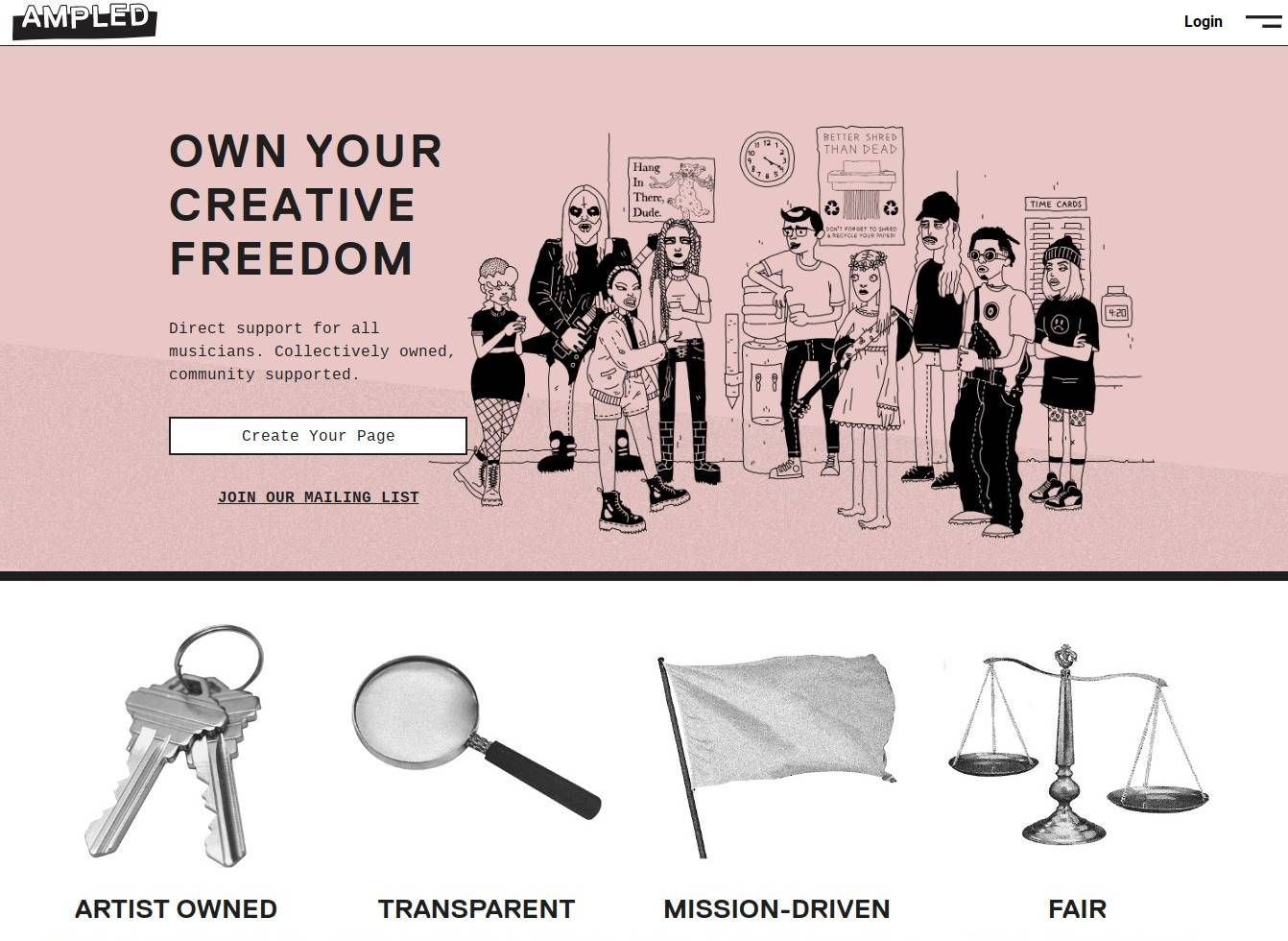
In the music realm, the first such project working along these lines was Resonate, which aimed to become a streaming alternative to Spotify based on a user centric "stream-to-own" model—Resonate founder Peter Harris spoke at the aforementioned New School conference in 2015. Four years later, product designers Collin Lewis and Austin Robey co-founded Ampled, a musician-focused patronage tool that provided an alternative to Patreon. Both Ampled and Resonate were designed as multi-stakeholder cooperatives, meaning that governance of the platform was shared by three member classes: workers whose labor went into creating the product, artists using the platform, and supporters who provide direct financial support to the platform. (Ampled called this member class "Community members" rather than supporters.) Each member class voted to elect a representative number of board members, who held ultimate fiduciary responsibility for the business with a one-member, one-vote system, rather than investors holding shares that convey proportional voting rights based on capital contributions.
Both projects were still active in 2022, although I quickly came to learn that Resonate might not be on solid footing when I tried to join as a supporting member and their payment processing system rejected my payment due to a bug in the code; activity on their public user forum had also dwindled to nearly zero.
Ampled was still accepting new members, so I joined their Discord and connected with one of their worker-members to learn how to get involved. By that point, Lewis had already left for paying work elsewhere. Robey had also just agreed to take another paying job, so the future of how core work on the platform would be organized was unclear.
This situation highlights one challenge to starting these cooperative initiatives: the significant barriers to accessing aligned capital investment in such a high-risk sector. Whereas large venture capital firms or major record label conglomerates can make large speculative bets on a variety of risky projects in the hopes that one of them returns an immense profit through scaling, user lock-in, and monopolization, the much smaller cooperative financing institutions tend to lend to more traditional brick-and-mortar businesses with a more obvious short-term revenue model. As such, most of Ampled's workers had yet to be paid for their labor, although Ampled intended to "buy back" the time in the future if the initiative became profitable. Working on the platform also granted the right to vote (and run) for one of the worker-member slots on the board of directors.
Given that my main interest in Ampled was as a tool to help restart my own musical practice and connect with supportive listeners, I instead chose to enter the organization through the Artist-Owner pathway. Artist-owner membership rights were conferred once an artist using the platform met a certain threshold of paying supporters. Ampled's revenue model, like Patreon's, was based on drawing a percentage of whatever artists earned there. Artists could choose between 7%, 10%, or 13% as Ampled's platform cut.
Once I met that threshold, an automated workflow sent a congratulatory email and notified me of my newly conferred rights to run for and vote on artist-owner board members, as well as access to an artist-members-only space of the Discord server. The automated bot informed me that I was the first new member to join the space in months, and given the lack of activity there I had a hunch that I would be the last.
Sure enough, a few months later, rather than announcing a new board election, Ampled notified its members that it would be shutting down at the end of 2023. We had about six months to export any content we had produced for the platform; the website now directs to an archive of the project's former existence. Members were not afforded any opportunities to weigh in on the decision to close, despite language in the organization's bylaws that stipulated this. Robey, who seemed overwhelmed by the prospect of trying to maintain Ampled while working elsewhere, did not respond to my attempts to communicate via Discord until after the project closure had been announced. The following year, Robey presented a postmortem talk for the Platform Cooperativism Consortium; my request to contribute this artist-owner's perspective was declined.
The news did not come as a surprise, although it was a bit disappointing to have my hunch confirmed. Even without an active member community, the tool was providing a real benefit to me and a handful of other musicians as a small source of consistent income among these core supporters—as well as a sense of what independent photographer Craig Mod calls "permission," that sense that what you are doing as an artist matters to someone else.
By then, I had also met a group of software developers who had been volunteering their time trying to breathe new life into Resonate, only to be met with similar challenges. Around this same time, the music platform Bandcamp, darling of the independent music world often held up as a "fair trade" alternative to streaming, was sold for the second time in two years, to the Australian music licensing firm Songtradr, in an asset sale that led to the dismissal of half of its employees—including the entire bargaining committee of the company's newly formed union. Our little group of dreamers and coders realized that we had the collective experience to spin up something new in the ashes of these other cooperative experiments that could address this challenge, which led to us founding Mirlo, a music distribution software that includes an optional patronage and direct payment system. That story continues to be written—so let's talk about that another time!
With the time I have left, I'll close with a few scattered reflections on what I've taken away from this experience, with an ear towards how researchers such as yourselves could make much-needed contributions to what is emerging:
- It seems worth noting that these platform cooperative initiatives have emerged alongside parallel developments in federated social media protocols, which have enabled alternative tools such as Mastodon, Bluesky, and Pixelfed. Especially in Europe, there seems to be increasing overlap between the technical and social protocols that are powering these initiatives. Mirlo, for example, has been championed by artists who discovered it (and one another) through the federated microblogging tool Mastodon.
- Still, the practicalities of sustaining these initiatives beyond their initial phases remains fraught. Without startup capital or other ways for significant funding to support full-time work on the projects—both the interwoven projects of artists making music, building the software, and building sufficiently trusting relationships for meaningful cooperation to be possible. Ampled and Resonate showed that even with an elegant multi-stakeholder cooperative legal structure, an organization is only able to self-govern if there is enough of a reason for the people involved to prioritize that work over other things in their life. When those trade-offs involve making enough money to pay rent, the pool of people who can contribute volunteer effort is artificially restricted to those who are already well enough off to afford to spend time in ways that may not be financially remunerative. For most musicians, this is even more of a double-bind, because many are unable to generate enough money from their music to cover their bills in the first place.
- Lastly, I'd like to point out that the translocal nature of these initiatives invites significant opportunities as well as challenges. The opportunities lie in being able to weave global-scale networks in the so-called "long tail" of music distribution. Artists who do not make music that is friendly to the streaming services or algorithmic social media feeds can find like-minded artists and listeners to build a critical mass to sustain their practice beyond what their local or regional music scenes might afford. For example, Catalytic Soundstream is a promising experiment along these lines. At the same time, it is difficult to cultivate the type of high-trust, in-depth, collaborative relationships that characterize cooperative businesses when interactions are limited to online communication tools like Discord chats, video calls, and project management software. Language barriers complicate this even further.
So one project ends, another begins, with many of the same people—and variations on the same open-source code—reinvented and recombined in a new attempt to meet the moment and build viable alternatives to the behemoths of digital capitalism. As this new chapter unfolds, I look forward to further exploring these dynamics with you in the years ahead.